Crawl Space Mold Remediation in Carson City, NV
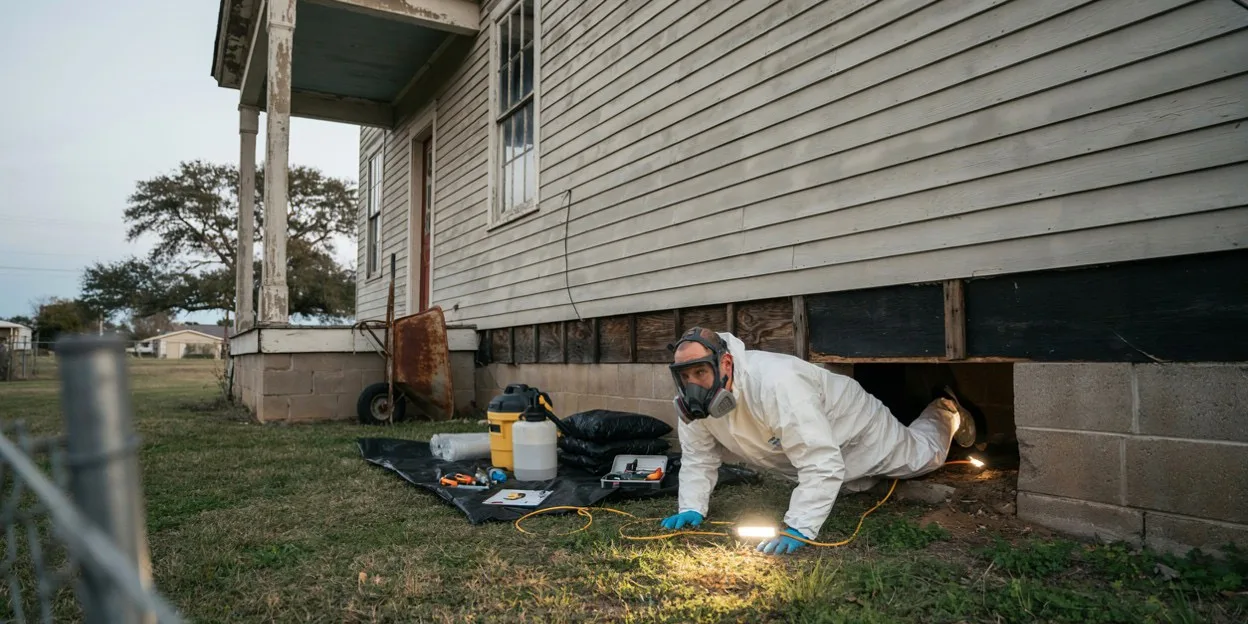
The living room has smelled damp since the snow went off the north side of the house, and when you finally pulled the hatch in the hall closet and shone a light in, the joists were furred with white and gray and the insulation was sagging in wet sheets. This site connects you by phone with an independent local provider who does crawl space mold remediation in Carson City and the Carson Valley.
What the crew does first
Someone goes under the house with a light, a respirator, and a moisture meter and maps it: which joists and how much of the subfloor are affected, whether the insulation is wet, whether there is standing water or damp soil, and where the water is coming in. In Carson City that is usually one of four things: snowmelt seeping through a stone or block wall, a plumbing line that froze and split, a downspout dumping against the foundation, or vents closed for winter and never reopened.
Containment in a crawl space means sealing the hatch and any floor openings to the living space, and running a HEPA air scrubber as negative air so the work does not push air upstairs. The furnace ducts that run through the crawl space get checked for open joints and sealed off during the work.
What to do in the next hour
Close the hatch and do not go back in without a respirator. Do not pull the wet insulation out yourself; that is the surest way to fill the house with spores. If there is standing water and you can find the source, shut the valve. If it is snowmelt, redirect the downspouts and move the snow pile away from the foundation.
Turn off the furnace fan if the ducts run through the crawl space. Take a few photos from the hatch with a flashlight.
What is usually saved and what is removed
Wet insulation, any vapor barrier, and stored junk come out in bags through the hatch. Joists, beams, and the underside of the subfloor are cleaned, often by HEPA vacuuming, wire-brushing or light sanding, and wiping; heavy growth on the subfloor sometimes means a section comes out from above. Stone, brick, and block walls are cleaned and left in place.
Then the space is dried with equipment until the wood reads dry. Fixing the moisture is the part that decides whether you call again next year: grading, downspouts, a new vapor barrier, a sump, or a repaired line, depending on the house. If the growth came up through the floor into a wall, that becomes mold removal in the room above. A smell that outlasts the cleaning is mold odor removal.
Carson City notes: old foundations, closed vents, and spring
The 1860s to 1920s houses on the West Side sit on stone or brick foundations with shallow crawl spaces and, in some cases, dirt-floor cellars. Those walls wick water, and every spring the snow along the north side of the house melts straight into them. The ranch homes of the 1950s to 1970s have block stem walls and screened vents, and a lot of those vents get stuffed with foam in November and forgotten.
A crawl space here is dry most of the year, which is exactly why a wet April goes unnoticed. The smell comes up through the floor gaps and the plumbing openings under the tub, and by the time it is strong enough to notice in the living room the joists have been damp for weeks. Homes along the Carson River in Empire and Dayton that took water in 1997, 2006, or 2017 can carry growth under the floor from those years.
Ask the crew for the moisture readings on the joists before the new vapor barrier goes down, and for photos of the cleaned wood. If you want an independent check, an assessor you hire separately can look at the space afterward.
Calling about crawl space mold remediation
Have the address, what you saw from the hatch, and whether there is standing water. Say whether the house is on a stone, block, or poured foundation if you know. Call (775) 242-6705.